
What is Feng-Shui?
Introduction to Feng Shui
Feng Shui is an ancient Chinese practice that aims to harmonize individuals with their surrounding environment. The term literally means “wind” (Feng) and “water” (Shui), symbolizing the flow of life force energy—Chi—through a space. By understanding and applying Feng Shui principles, one can attract prosperity, health, and positive energy.
According to Merriam-Webster Dictionary, a Chinese geomantic practice in which a structure or site is chosen or configured so as to harmonize with the spiritual forces that inhabit it also : orientation, placement, or arrangement according to the precepts of fengshui.
1. The Concept of Chi
Chi (also spelled Qi) is the vital energy that flows through everything. In Feng Shui, promoting good Chi involves arranging furniture, decor, and architecture in ways that support its smooth flow. Stagnant or obstructed Chi can lead to imbalance and disharmony.
2. The Commanding Position
This principle involves positioning key furniture—such as beds, desks, and stoves—so that you can see the room's entrance without being directly in line with it. This provides a sense of security and control.
-
In general, you can achieve the commanding position by:
- Placing furniture against walls
- Floating desks so that your back is against the wall while you sit facing it
3. The Bagua Map
The Bagua map divides a space into nine areas, each corresponding to an aspect of life, such as wealth, health, career, or love. By mapping your space and enhancing specific zones with corresponding elements and colors, you can strengthen those life areas.
4. The Five Elements
Feng Shui incorporates five elements—Wood, Fire, Earth, Metal, and Water—each representing unique qualities and directions. Balancing these elements through color, shape, and materials can positively influence your environment and well-being.
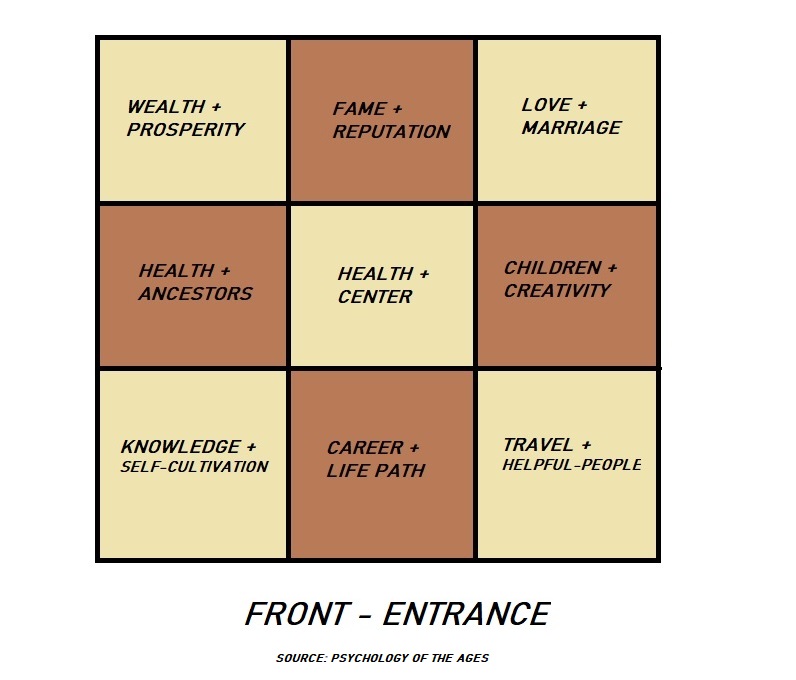
5. Colors and Elements by Bagua Area
- Wealth & Abundance (Xun): Purple, green, wood element
- Fame & Reputation (Li): Red, fire element
- Love & Relationships (Kun): Pink, earth element
- Family & Health (Zhen & Tai Qi): Green, yellow, wood & earth elements
- Creativity & Children (Dui): White, metal element
- Helpful People & Travel (Qian): Gray, metal element
- Career & Life Path (Kan): Black, water element
- Knowledge & Self-Cultivation (Gen): Blue, earth element
Conclusion
Feng Shui is more than just interior design; it's a holistic system for aligning yourself with the energies of the universe. By applying its principles—such as Chi flow, Bagua mapping, and elemental balance—you can create a home that nurtures your goals and emotional well-being.
📚 Related Articles:
- Learn how Vastu Shastra and Feng Shui align energies through spatial design for harmony and prosperity.
- Explore how Numerology complements Feng Shui by influencing your home’s energy through house numbers and personal digits.
- Enhance your Feng Shui practice by understanding your yearly horoscope and planetary alignments.
- Discover how self-development is empowered when your space supports clarity and intention.
- Apply Feng Shui principles to your emotional well-being using psychological behavior insights
- Find out how Angel numbers and divine synchronicities connect with Feng Shui symbolism and intention-setting.
- Combine the ancient wisdom of astrology with Feng Shui for personalized guidance in your home and life design.
- See how Palmistry reveals personality traits that affect your energy flow and environmental needs.