
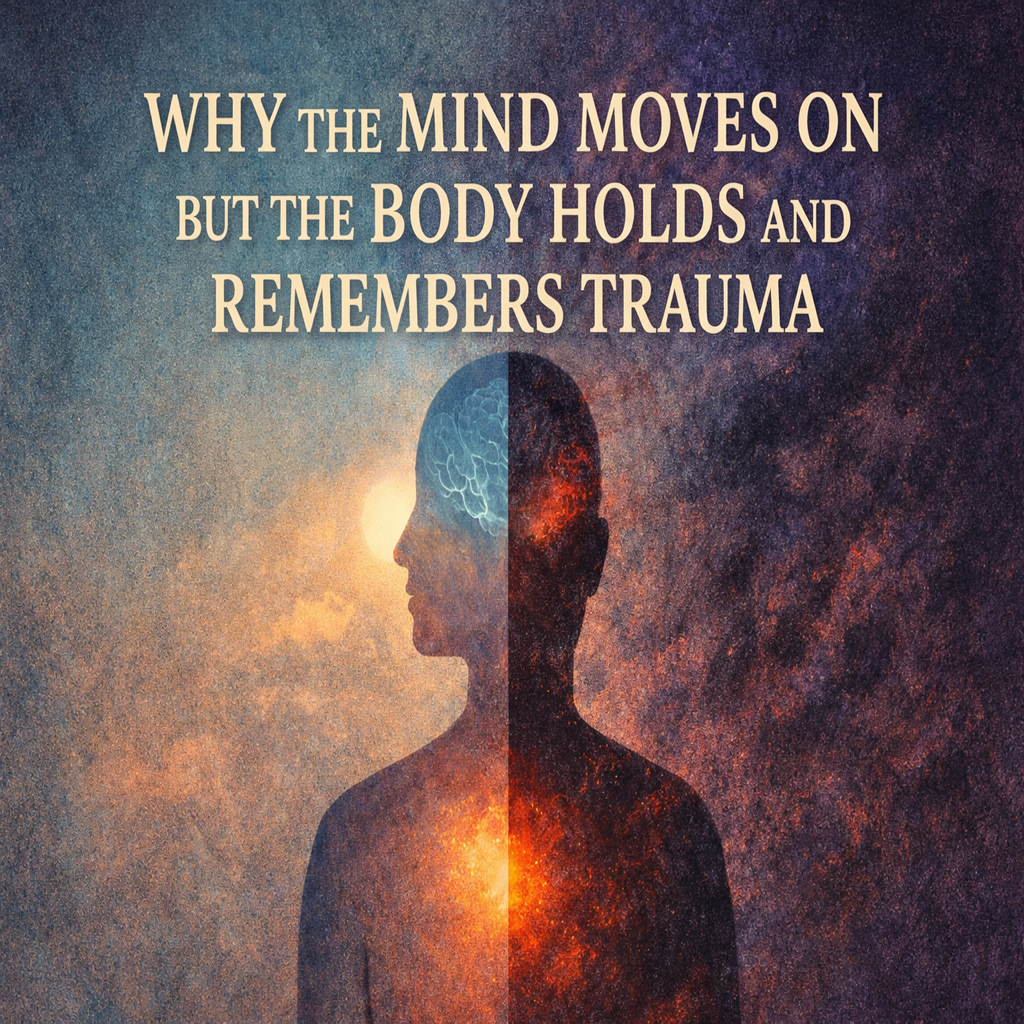
Why the Mind Moves On but the Body Holds and Remembers Trauma
Why the Mind Moves On but the Body Holds and Remembers Trauma
Sometimes a difficult experience appears to be over, yet the person who lived through it continues to feel its effects. They may understand that they are now safe but still become tense when they hear a familiar sound. They may struggle to sleep, feel unusually alert in certain environments, or notice a racing heart during situations that resemble an earlier frightening event.
This experience helps explain why trauma recovery can feel more complicated than simply remembering what happened and deciding to move forward. Emotional learning, bodily sensations, habits, and stress responses can continue to influence how a person reacts to the present.
The phrase the body remembers trauma is often used to describe this mind-body connection. It is a useful metaphor when it refers to learned physical and emotional responses. It does not mean that memories are literally stored in muscles as complete recordings of past events. Rather, the brain and body can develop patterns of threat detection, tension, arousal, avoidance, and emotional response that persist after a danger has passed.
When Healing Feels Incomplete
A person may be able to discuss a painful experience calmly while still feeling uneasy when something reminds them of it. Another person may have difficulty describing the event but notice tension, stomach discomfort, restlessness, or a strong urge to leave a particular situation.
These experiences do not automatically indicate trauma. Physical symptoms can have many psychological and medical explanations, and a person can respond to stress differently at different times. However, when reminders repeatedly bring back intense fear, helplessness, or a sense of danger, it can be useful to explore whether an earlier experience is influencing the present.
Recovery is not always a straight line. A person may feel better for a period and then notice old reactions returning during a stressful week, a major life transition, or a new experience that resembles something painful from the past.
Trauma Is More Than a Memory
Trauma is often discussed as an event, but its psychological effects can also involve how a person interprets danger, trusts others, manages emotions, and responds to reminders. Experiences that overwhelm a person ability to cope may affect their sense of safety and their expectations about what might happen next.
When a situation feels threatening, the body can prepare for action. Heart rate may increase, muscles may tense, breathing may change, and attention may narrow toward possible danger. These responses can be helpful during a genuine emergency. Difficulties may arise when a similar response is triggered in a situation that is no longer dangerous.
For example, a person who experienced repeated criticism may become tense whenever someone raises their voice. The present conversation may be manageable, but the tone can resemble earlier experiences and trigger an automatic defensive response.
The reaction is real, but it is not proof that the current situation is identical to the past. Learning to recognize this difference can be an important part of recovery.
How the Brain and Nervous System Respond to Threat
1. The Stress Response
When the brain detects possible danger, it can activate systems that prepare the body to respond. These changes may include faster breathing, a pounding heart, increased muscle tension, heightened alertness, or changes in digestion. The exact response varies from person to person and depends on the situation.
After a frightening experience, reminders of the event may sometimes activate similar responses. A sound, location, facial expression, or interpersonal situation can become associated with danger. The response may occur before the person has consciously worked out why they feel uncomfortable.
2. Learned Associations and Triggers
The brain learns from experience. If a particular situation repeatedly occurs alongside fear or harm, elements of that situation may later become warning signals. A person who was hurt in a relationship may feel anxious when a new partner becomes distant, even when the reason for the distance is unknown.
A trigger is not a reliable prediction of what will happen next. It is a cue that may activate a learned response. Noticing the cue allows a person to pause, examine the current evidence, and decide what is needed now.
3. Memory, Attention, and Avoidance
When a person expects danger, attention may become more sensitive to signs of threat. They may monitor other people expressions, anticipate criticism, or avoid places that remind them of a difficult event. Avoidance can provide short-term relief, but when it becomes extensive, it may interfere with daily life and prevent a person from discovering that some situations are now safe.
Not every avoidance response should be challenged. Avoiding a genuinely dangerous person or environment can be protective. Any gradual approach to feared reminders should be appropriate to the circumstances and, when symptoms are significant, guided by a qualified professional.
Why Talking About an Experience May Not Resolve Every Reaction
Talking can help people organize memories, understand what happened, challenge self-blame, and receive support. For many people, verbal reflection is an important part of recovery. Yet understanding an experience intellectually does not always make every emotional or physical reaction disappear immediately.
Different aspects of recovery may require different approaches. Someone may benefit from understanding their beliefs, practising emotional regulation, rebuilding trust, improving sleep, learning grounding skills, or receiving a structured psychological treatment.
This does not mean that talking therapy is ineffective or that a person must physically release stored trauma to recover. Evidence-based trauma treatments vary in approach, and a qualified clinician can help determine what fits a persons needs and preferences.
Signs That Stress Responses May Still Be Affecting You
People experience stress differently. Some possible signs that deserve attention, particularly when they are persistent or linked to a distressing experience, include:
- Feeling unusually alert or easily startled in situations that seem safe.
- Difficulty relaxing, even after the immediate problem has passed.
- Repeated nightmares or unwanted memories related to a frightening experience.
- Avoiding reminders because they bring intense distress.
- Feeling detached, numb, or disconnected during stressful situations.
- Sleep difficulties, irritability, or trouble concentrating.
- Physical tension or discomfort that becomes worse during emotional stress.
These signs are not a diagnosis and can occur for many reasons. If symptoms are persistent, severe, or interfere with daily functioning, a medical or mental health professional can help assess their cause.
Practical, Trauma-Informed Ways to Support Recovery
1. Start With Present-Moment Grounding
If a reminder leaves you feeling overwhelmed, gently orient yourself to the present. Look around and identify the place you are in, notice the date if that helps, and describe a few neutral objects in the room. Feel the support of the chair or the floor beneath your feet.
The purpose is not to force the emotion away. It is to help you notice the difference between remembering a difficult experience and being in that experience again. If focusing on your surroundings increases distress, stop and choose another form of support.
2. Notice Bodily Sensations Without Forcing Change
If it feels comfortable, notice whether your shoulders are tense, your jaw is clenched, or your breathing has become shallow. Describe the sensation neutrally rather than treating it as evidence that something terrible is about to happen.
You do not need to scan your entire body or remain focused on uncomfortable sensations. For some people, inward attention can intensify distress. Keeping your eyes open, focusing on the environment, or talking with a trusted person may feel safer.
3. Use Gentle Movement
Comfortable walking, stretching, or other gentle movement may help some people reconnect with the present and reduce everyday tension. Choose an activity that feels safe and appropriate for your physical health. There is no need to perform intense exercise or push through pain in order to process an emotion.
4. Build Predictable Daily Routines
Regular sleep and wake times, nourishing meals, manageable activity, and supportive social contact can provide structure during stressful periods. These habits do not erase trauma, but they can support general wellbeing and make daily demands more manageable.
If sleep problems persist or physical symptoms are new, severe, or unexplained, seek medical advice rather than assuming that they are caused by trauma alone.
5. Practise Emotional Regulation
When you notice a strong reaction, try naming the emotion, identifying the immediate trigger, and considering what you need. You might need a pause, clearer information, a boundary, reassurance, or help with a practical problem.
Explore The Art of Emotional Regulation: Turning Chaos into Calm for additional techniques that can help create space between a feeling and an action.
How Professional Trauma Support Can Help
If trauma-related reactions are persistent or distressing, a qualified mental health professional can assess what is happening and discuss appropriate treatment options. Depending on the individual situation, evidence-based approaches may include trauma-focused cognitive behavioural therapy or eye movement desensitization and reprocessing, commonly known as EMDR.
These treatments are not appropriate for every person in every circumstance, and the choice should be made with a trained professional. A clinician can also consider other explanations for symptoms and help establish a pace that feels manageable.
Recovery should not be forced. You do not need to revisit painful memories without support, recreate distress, or attempt to uncover hidden memories. Feeling overwhelmed is a reason to slow down and seek guidance, not a sign that you have failed.
The Role of Safety, Boundaries, and Supportive Relationships
Emotional recovery is affected by the environment in which a person lives. It can be difficult to feel safe when someone continues to threaten, control, or mistreat you. In such circumstances, practical safety, supportive people, and appropriate professional assistance may be more important than self-reflection exercises.
Supportive relationships can provide opportunities to experience respect, consistency, and honest communication. However, no individual should be expected to act as another person therapist, and a partner cannot single-handedly resolve the effects of trauma.
For more on communication and boundaries, read Healthy Relationship Tips. To explore how hidden emotional patterns can influence reactions, see Shadow Work: Understanding Hidden Emotions and Personality Patterns.
What Does It Mean to Release Stored Emotions?
The phrase releasing stored emotions is commonly used in wellness discussions to describe acknowledging feelings, reducing tension, or working through distress. It should not be taken as proof that a particular emotion is physically trapped in a muscle and must be expelled through a specific movement or exercise.
People may experience relief through talking, writing, supportive relationships, relaxation, movement, or psychological treatment. Others may need medical evaluation or more structured care. Responses differ, and no single technique works for everyone.
Rather than searching for one dramatic release, focus on whether a practice helps you feel more grounded, function more effectively, and respond to daily situations with greater flexibility.
Conclusion: The Body Is Not Broken
The idea that the body remembers trauma points to the ways that past experiences can influence present-day stress responses, sensations, attention, and behavior. It is a reminder that recovery may involve more than understanding a memory intellectually.
At the same time, bodily symptoms do not automatically prove that trauma is present, and trauma should not be reduced to a literal storage of memories in the muscles. Physical health, current stress, learned associations, and individual circumstances all deserve consideration.
Begin gently by noticing what you experience, orienting yourself to the present, building supportive routines, and seeking qualified help when needed. Recovery is not about forcing your body to forget. It is about gradually developing a greater sense of safety, choice, and confidence in the life you are living now.
Continue reading Emotional Regulation, Shadow Work and Hidden Patterns, and Stress and Aging.
Editorial note: This article is educational and is not a diagnosis or a substitute for professional mental health or medical care.